Posts

Dynamic data use-case for d3.js
Image
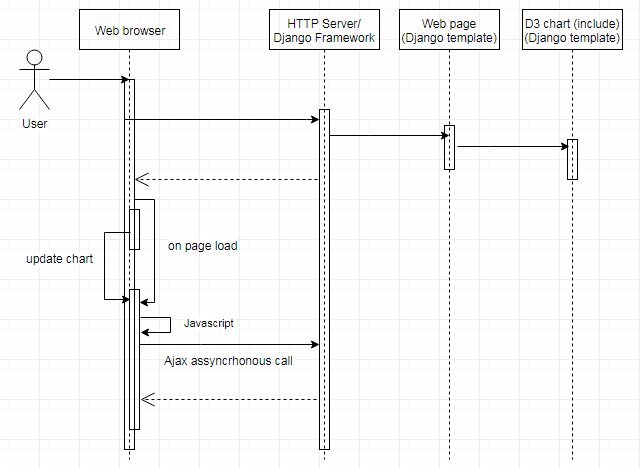
I have been using d3.js in a production environment for about 3 years. And now due to some features upgrade on our website some changes need to be made on our charts. I decided to put this on paper to document and share this experiments. To play with d3.js, you have to deal with some technologies: Javascript Css Ajax Server-side (Python/Django) for me For this system I also use Solr to deliver graph data. System overview The portal ( https://bv.fapesp.br ) is a standard web site that loads dynamic data from relational database and nosql database. To display analytics charts, we use d3.js. The diagram below shows the communication layer between the components, to load d3.js charts on the front-end of BV FAPESP. Essentially, we use d3.js just like that, a javascript framework to display chart data. However, when you have to load data dynamically in a couple of charts, these things need to be a bit elaborated. BV FAPESP portal makes use of some d3.js charts seemin...

Solr - Graph traversal query

Image
In this document I will show you how I am using some distinct technology layers to display graph data from BV FAPESP, stored inside Solr. FAPESP´s virtual library (BV FAPESP) is the information system, source of the referential data, of funded projects from São Paulo funding agency. These projects holds relation to each other in a three structure, a specialized form of a graph structure. BV FAPESP data projects structure In the relational database, the projects are linked by foreign keys, the most simple form to store the three structure relationship. But the main data source of BV FAPESP, is not a relational database, but the search engine Solr. Solr is a search engine, that uses the inverted index structure which is very fast at query time. The initial approach At the early stages of BV FAPESP, the associated projects were indexed with some kind of information from their parent, to allow the inverted search to get all children of a subset of projects. Everything is...

Atom - Jupyter / Hydrogen

Image
I will show you how to use the Atom editor with Jupyter Notebook to debug Python/Django views using Hydrogen plugin. On the Internet you can find some examples using this setup to debug Python but I found nothing related to Django, so I decided to publish this notes. This is not a high performance setup, because it involves many technologies at several layers. This is more a proof of concept of nowadays technologies which are available to the programmer's toolbox. This notes has been written during the development and improvement of the automated tests of the Virtual Library of FAPESP ( http://www.bv.fapesp.br ). The environment The diagram below shows an actual infrastructure to use this setup in a development environment. Technologies It is not expected that you know all of the technologies in detail, but there are some trick points. This paper is oriented for Python programmer who already use Atom and Jupyter and enjoy explore the edges of these tools. ...

Solr Facet add link

Image
This is about how to link the resulting facet data from Solr on your web application. I am using Django as the front-end framework. But this solution applies to any language. The problem You have modeled your data and indexed to Solr. You will show facets on your web application to facilitate the navigation on your site to the users. You get faceted data from Solr; so far so good. The problem arises when you need to link your facet item to any destination other than the value of the facet itself, because Solr faceted data returns only the field value and count of occurences. The example below is a simplification of the Solr facet web page 1 , and show you how the json facet returns: {   "facet_counts" :{     "facet_queries" :{},     "facet_fields" :{       "categories" :[         "electronics" , 14 ,         "currency" , 4 , ...

Do Google Maps ao Open Street Map

Image
O objetivo deste texto é documentar algumas dificuldades encontradas para substituir o framework Google Maps pelo Open Street Map. Este texto não é um tutorial do OSM, seja no nível de instalação, configuração ou uso; e se limita a apresentar os detalhes de implementação específicos ao caso de uso do portal web Biblioteca Virtual da FAPESP (BV FAPESP - http://bv.fapesp.br ). Caso de uso A BV FAPESP utiliza mapas georreferenciados para apresentar informações de concessão de fomentos de Projetos de Pesquisa (Auxílios à Pesquisa e Bolsas de Pesquisa) relacionados às cidades de origem das Instituições-sede de pesquisa e instituições no exterior, quando o Projeto de Pesquisa se relaciona com alguma instituição no exterior. Deste modo é necessário que o sistema de mapas tenha uma abrangência global. A BV FAPESP sempre utilizou o framework de mapas Google Maps, porém o mesmo passou a cobrar pelos seus serviços à partir de Junho de 2018. Isso levou a uma decisão interna do projeto ...

Jenkins Gitlab Django

Image
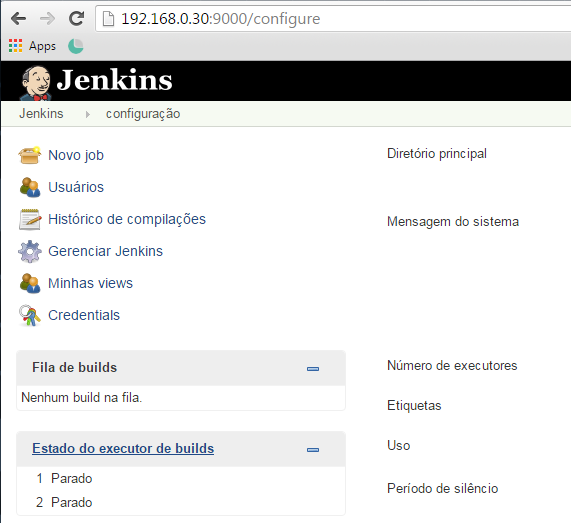
Instale o Jenkins de acordo com o seu sistema operacional O Jenkins é uma aplicação web JAVA autocontida, que utiliza o servlet container/HTTP server Jetty. O Jenkins roda como serviço, o que significa que uma vez instalado, basta você rodar o comando de acordo com o seu sistema operacional que o mesmo sobe tudo o que for necessário e fornece uma interface web para ser acessada via browser. Uma vez que o Jenkins está instalado e inicializado corretamente, basta acessar a página de adminstração do Jenkins na porta que você subiu a aplicação. A interface abaixo é uma tela da versão 2.7.4, que requer o Java jdk 1.7. Gitlab plugin Este plugin permite que o Jenkins faça os builds automaticamente quando houver um push ou merge de código no Gitlab. Instalar O mesmo deve ser instalado, pois não vem instalado por padrão no Jenkins. Para instalar plugins, clique no item de menu “Jenkins” > “Gerenciar Jenkins” > “Gerenciar Plugins”, conforme a figura abaixo. Certifique...

How to create a local GIT server for an existing project

This post will describe how to create a local Git server based on a existing project in a secure way, meaning that you will not have any risk to lose information, unless you delete something by your own. 1. Create a home directory for your Git server. This is a folder that will contain your versioned projects on Git. After you have everything set, you will connect here and clone your local copies and push changes you made. This will be your local Git server. mkdir < /home/git_server/> 2. Inside your Git server directory, initilize a Git repository for your existing project. This command creates an empty dir, where you will push your existing project´s cod e. cd < /home/git_server/> git init --bare < any_project_name .git>   Now your dir structure is something like this   < /home/git_server/ any_project_name .git> 3. Copy your working project to some tmp dir anywhere: cp -r  < your_project_dir> < copy_of_your_pro...